Yet for many researchers, NSF's complexity is the problem. Eight directorates, dozens of divisions, career-stage programs with distinct eligibility rules, and a proposal process governed by an evolving policy guide create real barriers — not because the research isn't fundable, but because navigating the system takes knowledge most scientists don't have time to develop.
This guide cuts through that complexity. It covers how NSF is organized, which programs match which career stages, how to find the right opportunity, what the review process actually involves, and what separates competitive proposals from those that score poorly.
Key Takeaways
- NSF funds non-medical science and engineering through eight directorates, each with distinct programs and deadlines
- Career-stage programs range from GRFP for graduate students to CAREER for untenured faculty — eligibility rules differ significantly
- Contacting a Program Officer before submitting is standard practice, not optional
- Every proposal must address both Intellectual Merit and Broader Impacts; weak Broader Impacts is a common, avoidable failure
- NSF's agency-wide funding rate was 19% in FY2025 — proposal quality and fit to program are decisive
What NSF Funds and How It Is Organized
NSF's statutory mission covers fundamental science and engineering across all fields except the medical sciences. Disease mechanisms, diagnosis, and treatment fall outside scope — though qualifying bioengineering, assistive technology, and computational biology work can remain eligible. This distinguishes NSF from NIH (health-focused) and DOE (energy and national security missions).
That scope maps onto a clear organizational structure. Research is funded through eight directorates:
| Directorate | Acronym |
|---|---|
| Biological Sciences | BIO |
| Computer and Information Science and Engineering | CISE |
| Engineering | ENG |
| Geosciences | GEO |
| Mathematical and Physical Sciences | MPS |
| Social, Behavioral and Economic Sciences | SBE |
| STEM Education | EDU |
| Technology, Innovation and Partnerships | TIP |
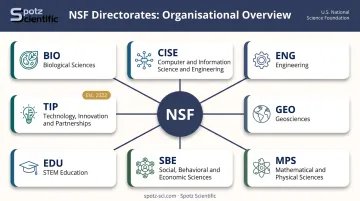
TIP is the newest, established in March 2022 — NSF's first new directorate in over 30 years. Each directorate contains divisions and programs with their own solicitations, deadlines, and funding levels.
Award Types
NSF makes four main types of awards:
- Standard Grants — fixed support for a specified period; no expectation of continuation without a new proposal
- Continuing Grants — initially fund one year, with additional increments subject to satisfactory progress
- Cooperative Agreements — involve substantial NSF participation in the work
- Fellowships — awarded to individuals, not institutions; fellows carry funding to their host institution
Some programs accept proposals on a rolling basis; others run on annual solicitation cycles with firm deadlines. Missing a deadline typically means waiting a full year for the next submission window — so confirm the specific solicitation's timeline early in your planning process.
NSF Funding Opportunities by Career Stage
Graduate Students: GRFP
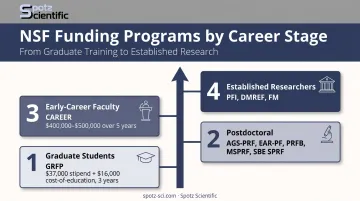
The NSF Graduate Research Fellowship Program (GRFP) is the primary pathway for graduate students. NSF announced 2,500 fellowships for 2026–2027 — each providing a $37,000 annual stipend plus $16,000 cost-of-education allowance for three funded years within a five-year period.
Eligibility requirements:
- U.S. citizen, national, or permanent resident
- Enrolled in or applying to a research-based STEM master's or doctoral program
- Early in graduate training (specific timing rules apply — check the active solicitation)
GRFP fellowships are awarded to individuals, giving recipients flexibility in choosing or changing their host institution.
Early-Career Faculty: CAREER Award
The Faculty Early Career Development (CAREER) Award is NSF's most prestigious early-career grant. Key parameters:
- Minimum award: $400,000 over 5 years (or $500,000 for BIO, ENG, and OPP)
- Requires an integrated research-and-education plan — not just a strong science narrative
- Applicant must hold a doctorate, an at-least-50% tenure-track appointment, and be currently untenured
- No prior CAREER award permitted
The education component is where many proposals fall short. It must be substantive and connected to the research — not a list of generic outreach activities.
Research Initiation Programs
Engineering Research Initiation (ERI) supports engineering faculty at non-R1 institutions who have not received significant prior federal funding. Terms: up to $200,000 including indirect costs over 24 months. Eligible PIs may not have received $200,000 or more in federal research support during the prior five years. ERI is currently active.
The CISE Research Initiation Initiative (CRII) offered similar support for CISE researchers — up to $175,000 over 24 months — but its most recent solicitation is archived. Researchers interested in CRII-type opportunities should monitor NSF's funding portal for any reissued solicitation.
Postdoctoral Researchers
NSF runs multiple postdoctoral fellowship programs, most awarded to individuals rather than institutions:
- AGS-PRF — atmospheric and geospace sciences; accepted on a rolling basis
- EAR-PF — Earth sciences, including interdisciplinary development
- PRFB — biological sciences, including broadening participation tracks
- MSPRF — mathematics, statistics, and applications
- SBE SPRF — social, behavioral, and economic sciences
- MPS-Ascend — broadening participation in mathematical and physical sciences; currently archived
Established Researchers and Collaborative Teams
For funded researchers tackling larger problems, NSF supports several cross-directorate and translational programs:
- Partnerships for Innovation (PFI) — active; supports translation of research into societal benefits
- Future Manufacturing (FM) — active; funds foundational research enabling new manufacturing paradigms
- DMREF (Designing Materials to Revolutionize and Engineer our Future) — active; accelerates materials discovery through computation and experiment integration
- ExpandQISE (quantum information science) — archived; not accepting new proposals
- ExpandAI (artificial intelligence capacity building) — archived; not accepting new proposals
Watch for successor programs to archived initiatives through NSF Dear Colleague Letters.
How to Find the Right NSF Program
Using NSF's Search Tools
The primary resource is NSF's funding search portal, which lets you filter active opportunities by directorate, keyword, and deadline. It includes solicitations, program descriptions, and Dear Colleague Letters (DCLs).
All proposals are now submitted through Research.gov (FastLane was decommissioned in September 2023). Key submission logistics to keep in mind:
- Set up your Research.gov account well before any deadline — institutional registration takes time
- Most proposals can also be submitted through Grants.gov, but check each solicitation's specific instructions
Contact Program Officers Early
This is the most consistently underutilized strategy in NSF proposal preparation. Program Officers can:
- Confirm whether your research fits the program's scope
- Advise on whether a concept paper or letter of intent is appropriate
- Flag potential issues before you invest weeks in a full proposal
Program Officers expect this outreach. Most will tell you directly if a proposal is a poor fit, saving significant effort on both sides before you commit to a full submission.
Monitor Dear Colleague Letters
Staying current with Program Officers is one strategy; tracking the written signals NSF publishes is another. DCLs don't create new solicitations, but they reveal where priorities are shifting. They announce special topics of interest, supplemental funding competitions, and program changes. Tracking DCLs for your relevant directorates is an effective way to spot emerging opportunities before they become formal solicitations.
The NSF Proposal Process
Required Components
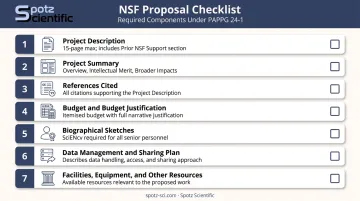
A standard NSF proposal under PAPPG 24-1 (effective May 20, 2024, and the current operative policy) must include:
- Project Description — maximum 15 pages, including Results from Prior NSF Support
- Project Summary — with separate Overview, Intellectual Merit, and Broader Impacts sections
- References Cited
- Budget and Budget Justification
- Biographical Sketches — prepared in SciENcv (mandatory since October 2023)
- Data Management and Sharing Plan
- Facilities, Equipment, and Other Resources
The Project Description must include a separately headed Broader Impacts section. Both merit criteria must be addressed in the Summary as separate labeled sections.
Pre-Submission Steps
Some programs require a concept paper, Letter of Intent, or preliminary proposal before a full submission. A missing required LOI can result in return without review — check the solicitation carefully.
The 4–6 week institutional notification window often referenced for sponsored research offices is institutional practice, not an NSF-wide rule. That said, budgets are complex and should be drafted in partnership with grants administrators early. Last-minute budget preparation is one of the more common sources of errors.
After Submission
Once submitted, NSF assigns proposals to Program Officers, who send them to at least three external reviewers — using ad hoc reviewers, an expert panel, or both. Reviewers score proposals on the two merit criteria and provide narrative comments. Ratings follow a five-point scale:
- Excellent
- Very Good
- Good
- Fair
- Poor
Unfunded proposals receive written reviews. Reading those reviews carefully and incorporating the feedback into a revised submission pays off — resubmission is normal, not a sign of failure.
What NSF Reviewers Look For
Intellectual Merit
Reviewers assess whether the proposed research advances knowledge and understanding. A strong proposal must:
- Articulate a clear, specific scientific question
- Explain why answering it matters — within the field and across adjacent areas
- Demonstrate that the PI and team have the expertise to carry it out
- Present an approach that is well-conceived and feasible
Broader Impacts
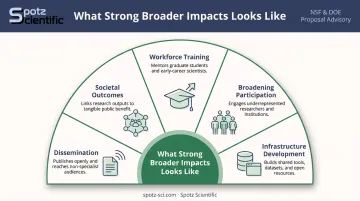
Broader Impacts is not a checkbox. Reviewers assess whether the research benefits society beyond the immediate scientific community. Strong Broader Impacts can include:
- Training the next generation of scientists
- Broadening participation of underrepresented groups in STEM
- Infrastructure development (datasets, software, shared facilities)
- Dissemination through open-access publication, outreach, or partnerships
- Tangible societal outcomes tied to the research outcomes
Weak Broader Impacts is one of the most common — and most preventable — reasons proposals score poorly. A generic plan names an activity (e.g., "give a public talk") without connecting it to the research, the community, or measurable outcomes. Reviewers can tell the difference between a section written with intention and one appended at the last minute.
Write for the Scientifically Literate Generalist, Not the Specialist
NSF review panels frequently include scientists from adjacent disciplines — not just specialists in your exact subfield. This matters because reviewers who can't follow the significance of the work will score it accordingly. The first two pages of the Project Description need to communicate the scientific question, its significance, and the approach clearly enough that a scientifically literate generalist understands why it matters. If your opening pages assume deep domain knowledge, you've already lost part of your panel.
Tips to Strengthen Your NSF Proposal
Read the solicitation as a checklist, not background reading. Every requirement is there for a reason. Program Officers flag proposals that address a program's general topic but ignore its stated priorities. Reusing a prior proposal narrative without adapting it to the specific solicitation is a reliable way to score poorly.
Run an internal red-team review before submission. Find colleagues unfamiliar with your specific project and ask them to read the proposal as if they were a reviewer. Focus their attention on three questions: Is the scientific question clear? Is the significance obvious? Is the Broader Impacts plan substantive? If the answer to any of those is uncertain, the proposal needs revision before submission.
Engage a proposal consultant for high-stakes submissions. The NSF CAREER award, large collaborative grants, and programs with complex requirements benefit most from outside expertise. Spotz Scientific offers red-team review and strategic advisory services for NSF submissions, with particular depth in the NSF CISE directorate, the primary home for scientific computing and computational research proposals.
Founder Bill Spotz spent eight years as a program manager at DOE's Advanced Scientific Computing Research office, managing over $264 million in research. That insider perspective informs every proposal review. Researchers who engage at least two weeks before the deadline qualify for the standard advisory rate; materials submitted inside that window are handled at an expedited rate.
Engage early. The worst time to start thinking about proposal strategy is two weeks before the deadline. Contact your Program Officer, loop in your grants office, and start the Broader Impacts section before the Project Description — not after.
Frequently Asked Questions
Who is eligible for NSF funding?
Eligibility varies by program. Most NSF research grants require the PI to be affiliated with a U.S. institution of higher education, eligible nonprofit, or — in some cases — a for-profit organization or government entity. Fellowships are typically awarded to individuals directly.
Are NSF grants still available?
Yes. NSF continues funding research across all its directorates. Check the NSF funding opportunities portal for active solicitations and current deadlines, as programs open and close on annual or rolling cycles.
How hard is it to get an NSF grant?
Competitive. NSF's agency-wide funding rate was 19% in FY2025, down from 26% the prior year. CISE and ENG directorate rates were 22% and 23% respectively in FY2024. Researchers who incorporate reviewer feedback and resubmit substantially improve their odds over time.
What is the NSF CAREER award and who can apply?
The CAREER award is NSF's premier early-career faculty grant, open to untenured tenure-track faculty. Proposals must meaningfully integrate research and education goals — not simply append outreach to an otherwise standard research plan.
What are the two NSF merit review criteria?
Intellectual Merit (advancing scientific knowledge) and Broader Impacts (benefiting society). Both must be explicitly addressed in the Project Summary as separate labeled sections, and the Project Description must include a separately headed Broader Impacts section.
How do I find the right NSF directorate or program?
Use NSF's funding search portal to browse by scientific area, then review recent awards in similar fields using NSF's Award Search tool. Contact relevant Program Officers directly before submitting — this conversation is both expected and genuinely useful.