Introduction
You type "sample grant proposal examples" into Google at 11 p.m., hoping something will make your DOE or NSF application feel less like a foreign language. Ninety seconds later, you're staring at a nonprofit RFP template for a community garden grant.
That's the problem. Most sample proposals online are built for foundation and nonprofit funding, not the technical rigor, specific aims, and 2 CFR 200-compliant budget justifications that federal scientific computing proposals demand.
This guide covers what a genuinely useful sample proposal looks like, where to actually find federal and scientific examples, and how to use them without copying language that reviewers will spot instantly.
Key Takeaways
- A strong sample shows you structure and tone, not sentences to lift word-for-word
- The best examples tie statement of need, methods, and budget into one logical argument
- NSF and DOE proposals include elements (broader impacts, data management plans) that generic templates skip entirely
- Real funded federal proposals beat generic web templates, but they take more digging to find
- Even a great sample won't catch every gap; that usually takes a second set of expert eyes
What Makes a Strong Grant Proposal Example?
A strong example builds a case for the work, not a project description alone. The problem statement is specific, backed by recent data, not vague claims about "important research gaps."
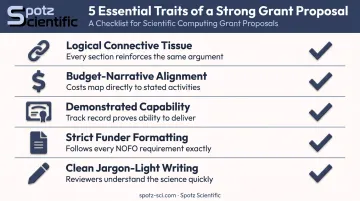
Look for these traits when evaluating any sample:
- Logical connective tissue between the research question, methodology, expected outcomes, and evaluation criteria. Reviewers shouldn't have to guess how one section supports the next
- Budget-narrative alignment, where every dollar requested maps to an activity actually described in the narrative
- Demonstrated capability, including prior publications, preliminary results, and institutional resources that establish credibility
- Strict adherence to funder formatting, not a generic one-size-fits-all structure
- Clean, jargon-light writing that a technical-but-not-subspecialist reviewer can follow without a dictionary
That last point trips up a lot of computational scientists. A proposal reviewer assigned to your panel might specialize in applied math but not your specific subfield. If your narrative only makes sense to someone who already knows your work, it's not doing its job.
The mismatch between budget and narrative deserves extra attention. It's the single most common flag reviewers raise: claiming a three-person research team's worth of activity while requesting funding for one postdoc, for example. A good sample makes that math obviously consistent. Check for that consistency, not the phrasing.
Where to Find Sample Grant Proposals for Federal & Scientific Research
Fully funded federal proposals are rarely public. NSF states plainly that proposals contain confidential and proprietary information, so what you'll find through NSF's Award Search is abstracts and award metadata, not complete narratives.
Abstracts are still useful for studying how funded PIs frame scope and significance within a target program.
Where to actually look:
- NSF Award Search and Research.gov — Study abstracts from funded projects in your target program to see how successful applicants frame scope
- DOE Office of Science program offices and national labs — ASCR and other program pages occasionally publish project summaries or PI-meeting materials that show how funded technical narratives are structured
- University Offices of Research or Sponsored Programs — Many maintain internal libraries of successfully funded proposals from faculty in similar fields
- Academic writing centers — Some universities publish annotated successful proposals useful for general structure, even when not scientific-computing specific
- Mentors and previously funded colleagues — Often your most realistic source; a redacted proposal from your subfield shows exactly what worked
What you should avoid leaning on: generic nonprofit RFP template sites. They're built for a completely different funding ecosystem. Federal scientific computing proposals require technical depth, compliance detail, and agency-specific documentation that a nonprofit template was never designed to model.
Anatomy of a Winning DOE/NSF Proposal: What to Look for in Sample Proposals
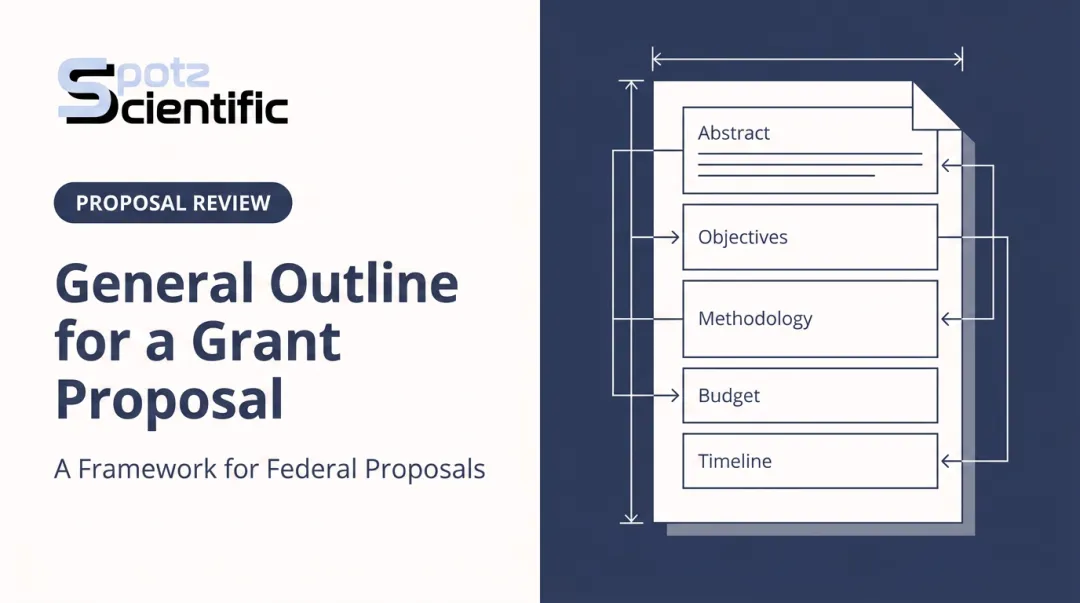
Nearly every proposal, federal or otherwise, includes the same basic skeleton: project summary, statement of need, project narrative/methods, budget and budget justification, and personnel qualifications. That's where the similarity to generic templates ends.
Federal Science-Specific Elements to Study Closely
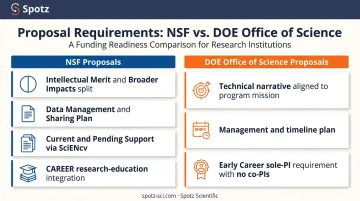
DOE Office of Science proposals require a technical narrative tightly aligned with the specific program's mission, plus a management and timeline plan demonstrating feasibility. Generic templates rarely model this level of program-specific alignment.
NSF proposals split the Project Summary into Intellectual Merit and Broader Impacts. They also require mandatory supplements: a Data Management and Sharing Plan (capped at two pages) and Current & Pending Support, both prepared through SciENcv.
If your sample doesn't show these documents, it isn't a complete NSF model. NSF's guidance on data management plans notes that even projects producing no data must justify that fact explicitly.
Early-career programs raise the bar further. NSF CAREER weights research–education integration heavily: a five-year Project Description where career development is woven throughout, not bolted on. DOE Early Career Research Program centers on a sole PI's individual research program, with no co-PIs permitted.
Generic samples almost never model this integration well. Nonprofit and foundation templates simply don't have an equivalent requirement.
Beyond narrative structure, strong samples also show how compliance sections are built. Budget justifications are where federal scrutiny gets sharpest. Every cost has to satisfy 2 CFR 200 cost principles: allowable, allocable, and reasonable.
Section 200.403 requires costs to be necessary, consistently treated, and adequately documented. That is a stricter bar than most foundation budget narratives ever demand.
Biosketches and facilities sections follow their own strict formatting, too. NSF's SciENcv-generated biosketch bears little resemblance to a standard resume attachment. Treating it like one is a fast way to trigger a compliance flag before a reviewer even reads your science.
How to Use Sample Proposals Effectively Without Copying
Once you've found a few decent samples, the temptation is to start pulling sentences. Don't. Use them as a structural checklist instead.
A better approach:
- Compare section-by-section against your own draft to confirm your narrative covers the same logical ground
- Review samples across different funders and programs to separate universal structure from solicitation-specific priorities
- Cross-check every claim and specific aim against the current Notice of Funding Opportunity
- Treat older samples as structural references only: a 2019 DOE narrative won't reflect this year's NOFO requirements
This last point matters more than most researchers assume. A sample proposal, even a funded one, reflects the solicitation it was written for.
Programs change emphasis, page limits shift, and new mandatory documents get added. Building your draft from a sample without checking the live NOFO leaves you compliant with a solicitation that no longer exists.
Once your draft exists, an outside reviewer who understands current DOE/NSF review criteria can spot strategic fit issues no template will catch on its own.
Common Grant Proposal Mistakes—and How Expert Review Helps You Avoid Them
The most frequent mistake reviewers flag is budget-to-narrative misalignment: a claimed project scope that the requested funding or staffing can't support. If your narrative describes a three-postdoc effort but your budget funds one graduate student, that gap undermines your credibility before a reviewer even reaches your methods section.
Other common missteps:
- Copying a generic sample too closely and skipping DOE/NSF-specific requirements (broader impacts, data management plans, program criteria)
- Assuming a resume works as a biosketch, when NSF requires a specific SciENcv-generated format
- Treating an older funded proposal as current compliance guidance without checking this year's NOFO
Self-review rarely catches these issues. It is hard to read your own proposal the way an unfamiliar reviewer will, and you know the project too well to spot where the logic has a gap.
This is where a red-team reviewer with funding-agency experience earns their keep. At Spotz Scientific, founder Bill Spotz spent eight years as a DOE Office of Science program manager, co-leading the applied mathematics program and overseeing more than $264 million in scientific computing research.
Having sat on the other side of the review table, he can simulate how a DOE or NSF panel will read your draft. That includes flagging budget mismatches, missing broader impacts language, or weak career-integration sections before a real panel sees them.
Spotz Scientific's red team review runs $250/hour under standard timing, or $300/hour if materials arrive less than two weeks before a NOFO deadline. You get a second set of eyes trained on DOE ASCR and NSF CISE review standards, not generic grant-writing advice.
Frequently Asked Questions
What is a grant request for proposal (RFP)?
An RFP is a funder's formal invitation describing available funding, eligibility, deadlines, and evaluation criteria. Federal science agencies more often call these "solicitations" or "Notices of Funding Opportunity" (NOFOs).
What is the difference between an RFP and a grant?
An RFP is the funder's invitation or announcement. A grant is the actual award of funds made after a successful proposal is submitted in response to that invitation.
How much money should I request in a grant proposal?
Request the actual, justified cost of your proposed work as detailed in your budget narrative. Stay within any program-specific award ceiling stated in the solicitation.
Where can I find real examples of funded NSF or DOE proposals?
Check NSF's public Award Search for abstracts, your university's research office archives, and colleagues who've been previously funded. Full proposal text is rarely made public.
Should I copy language directly from a sample grant proposal?
No. Federal reviewers can identify generic or reused language quickly. Use samples to study structure and tone, then write your own narrative in your own voice.
What is the difference between a grant proposal and a grant application?
The proposal is the persuasive narrative and budget justification. The application is the complete package, including required compliance documents, forms, and attachments.