Key Takeaways
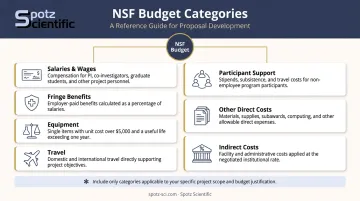
- NSF proposal budgets cover seven cost categories: salaries and wages, fringe benefits, equipment, travel, participant support, other direct costs, and indirect costs.
- The budget justification is capped at 5 pages and is reviewed as seriously as the scientific narrative.
- Key 2 CFR §200 thresholds: equipment at $10,000, subaward MTDC cap at $50,000, and a 15% de minimis indirect cost rate.
- Voluntary committed cost sharing is prohibited unless a solicitation expressly requires it.
- Misalignment between your science narrative and budget is a red flag for program officers.
What Is an NSF Proposal Budget?
An NSF proposal budget is the structured financial component of a research proposal — a line-item breakdown of every requested dollar, organized by cost category and budget year. It is governed by PAPPG II.D.2.f (currently NSF 24-1, effective May 20, 2024) and submitted through Research.gov, which requires both annual budgets and a cumulative budget.
NSF evaluates proposed costs as a distinct component from intellectual merit and broader impacts, assessing whether each item is reasonable, allowable, and allocable under 2 CFR Part 200. Program officers use this assessment to negotiate award amounts before funds are released.
Budget vs. Budget Justification
These are two distinct documents, and both are required:
- The budget form — a structured numerical table entered in Research.gov, listing costs by category and year
- The budget justification — a narrative document, maximum 5 pages per PAPPG II.D.2.f, that explains and defends every line item with a cost basis and research rationale
Reviewers read both. A strong numerical budget with a weak narrative justification can result in line-item reductions at the award negotiation stage.
NSF Budget Categories: What You Can and Cannot Include
NSF defines seven standard budget categories in PAPPG II.D.2.f. Not every project will use all seven — only include categories that apply to your specific research plan.
Senior/Key Personnel Salaries
The PI, co-PIs, and other senior/key personnel are those who contribute substantively to the project's scientific development or execution. Salaries are requested as a percentage of the individual's academic-year or calendar-year salary, reflecting actual effort committed to the project.
NSF does not prescribe a specific annual escalation percentage. Salary requests must align with your institution's consistently applied compensation policy — confirm the correct escalation basis with your sponsored programs office before budgeting.
Note: NSF generally limits senior personnel compensation to two months per year across all NSF awards combined.
Graduate Students, Postdocs, and Other Personnel
- Graduate research assistants (GRAs): Often requested at a flat institutional rate; fringe benefits are applied on top at your institution's negotiated fringe rate
- Postdoctoral researchers: Typically set by institutional pay scales, also subject to fringe benefit rates
- Fringe benefit rates: Obtain current negotiated rates from your sponsored programs office — do not estimate these independently
Equipment
Under 2 CFR §200.1 and §200.439, equipment is tangible property with a useful life of more than one year and a per-unit acquisition cost equal to or exceeding the lesser of your institution's capitalization level or $10,000.
General-purpose computing equipment requires careful justification — tie every item directly to a specific research task. A computing device below the equipment threshold may be charged as a supply if it is essential and allocable to the award, but capital expenditure on general-purpose equipment requires prior written approval under 2 CFR §200.439.
Travel
Domestic and international travel must be separately itemized with specific research justification (fieldwork, conference dissemination, site visits). Key compliance points:
- Under 49 U.S.C. 40118, federally funded air travel must use a U.S.-flag carrier — this applies even when a foreign carrier is cheaper, subject to Open Skies agreement exceptions
- International travel requires additional written justification beyond conference attendance
Other Direct Costs
This category covers several distinct subcategories, each requiring a separate justification:
- Materials and supplies — consumables directly used in research
- Publication and dissemination costs — open-access fees, page charges
- Consultant services — must specify daily rate, number of days, and expertise not available internally
- Computer services — cloud computing, HPC allocations, external computing time
- Subawards — each requires a separate detailed budget from the collaborating institution
Indirect Costs
Indirect costs (also called F&A costs) are calculated by applying your institution's Negotiated Indirect Cost Rate Agreement (NICRA) to the modified total direct cost (MTDC) base.
MTDC includes: direct salaries and wages, fringe benefits, materials and supplies, services, travel, and the first $50,000 of each subaward.
MTDC excludes: equipment, capital expenditures, patient-care charges, rental costs, tuition remission, participant support costs, and subaward amounts above $50,000.
Organizations without a current negotiated rate may elect the 15% de minimis rate under 2 CFR §200.414.
How to Write a Strong NSF Budget Justification
The budget justification is a narrative argument, not a restatement of numbers. Reviewers use it to assess whether you've genuinely thought through the cost of your research — and program officers use it to decide what stays and what gets cut.
Structure and Required Content
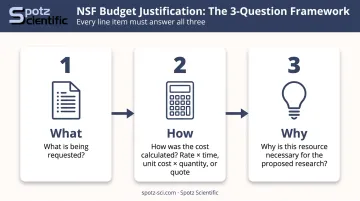
Address every category in the same order it appears in the budget form, using clear headers. For each line item, answer three questions:
- What is being requested?
- How was the cost calculated (rate × time, unit cost × quantity, quote)?
- Why is this resource necessary to execute the proposed research?
Personnel Justification
- PI and senior personnel: State the percentage of effort explicitly, and describe the specific scientific role in the project
- Graduate students: Justify the number requested and describe their planned contributions to research tasks
- Postdocs: Tie the salary level to institutional pay scale; explain the technical expertise they bring
- Consultants: Specify daily rate, number of days, and why this expertise is not available through existing institutional resources
Equipment and Compute Justification
For each equipment item, explain why existing institutional resources are insufficient for the proposed work. Include a cost rationale — a vendor quote or market comparison works well here. For HPC or cloud compute time, link the request directly to the computational workload described in the project narrative.
Internal Consistency Is Non-Negotiable
If your project description describes large-scale simulations, your budget must show compute time or HPC allocation costs. If you mention hiring a postdoc to lead experimental work, that person must appear in the budget. Common mismatches that draw scrutiny include:
- Simulations described in the narrative with no compute budget line
- Personnel named in the project description absent from the budget form
Program officers notice these gaps immediately, and they act on them.
Common NSF Budget Mistakes and How to Avoid Them
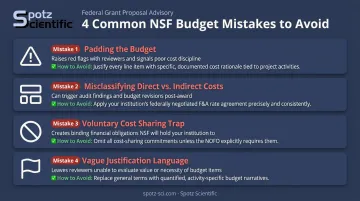
Padding the Budget
A larger budget does not signal greater ambition. Reviewers are trained to identify requests not clearly tied to the research plan, and padding undermines confidence in the PI's project management judgment. A lean, thoroughly justified budget is more competitive than an inflated one.
Misclassifying Direct vs. Indirect Costs
Administrative salaries are normally covered by indirect cost recovery and cannot be charged as direct costs unless all four conditions in 2 CFR §200.413(c) are satisfied:
- The services are integral to the project
- The individuals are specifically identifiable with the award
- The costs are explicitly included in the budget or have prior written approval
- The costs are not also recovered as indirect costs
Confirm cost classification with your sponsored programs office before submitting.
The Cost Sharing Trap
Many researchers include voluntary committed cost sharing — pledging, for example, 10% of the PI's effort without a corresponding budget request — believing it strengthens the proposal. NSF's policy prohibits this. Voluntary committed cost sharing is not allowed unless a solicitation expressly requires it. If included, it becomes a binding institutional obligation that must be tracked and documented post-award. An NSF OIG audit at one institution identified $55,464 in at-risk cost share — a post-award compliance problem that originated in a proposal commitment.
Vague Justification Language
Phrases like "supplies as needed" or "travel to relevant conferences" are not sufficient. Every line requires a specific cost basis and a clear research rationale. This is where many otherwise strong proposals lose ground during negotiation.
A red team review — the kind offered by Spotz Scientific — can surface vague justifications and classification errors before they reach a program officer's desk. Dr. Bill Spotz spent eight years as a program manager at DOE's Advanced Scientific Computing Research office, overseeing more than $264 million in research, and brings that reviewer's perspective directly to budget justification work.
Ignoring Solicitation-Specific Constraints
Before finalizing any budget, read the specific solicitation. Program announcements may impose total award caps, restrict indirect cost recovery, require specific line items, or limit certain cost categories. General PAPPG rules apply by default, but solicitation terms override them where they conflict.
Frequently Asked Questions
What budget categories can be included in an NSF proposal?
NSF defines seven standard categories: salaries and wages, fringe benefits, equipment, travel, participant support, other direct costs, and indirect costs. Only include categories relevant to your specific project.
How long should the NSF budget justification be?
The budget justification is capped at 5 pages per proposal under PAPPG II.D.2.f. Every line item in the budget must be addressed in this narrative with a specific cost basis and a clear research rationale. There is no minimum length requirement.
What is the difference between direct costs and indirect costs in an NSF budget?
Direct costs are expenses specifically tied to executing the research — personnel, equipment, supplies, and travel. Indirect costs (F&A costs) are institutional overhead expenses calculated by applying the negotiated indirect cost rate to the MTDC base. They cover shared infrastructure the institution provides, not project-specific expenditures.
Does NSF allow cost sharing in proposals?
NSF generally prohibits voluntary committed cost sharing. It is only permissible when a specific solicitation expressly requires it. Researchers who include unsolicited cost sharing create a binding obligation their institution must track and report throughout the award period.
Can I include graduate student tuition in my NSF budget?
Graduate student tuition remission is generally allowable as a direct cost when it reflects the institution's standard, consistently applied practice for GRAs on sponsored projects. Whether it's treated as direct or indirect depends on your institution's policy — confirm with your sponsored programs office before budgeting.
What happens if NSF reduces my budget after my proposal is recommended for funding?
NSF program officers routinely negotiate budgets before making an award. A reduction of 10% or more triggers a requirement for a revised budget, revised justification, and a Budget Impact Statement explaining how the reduced funding affects project scope.