That gap is expensive. A technically excellent proposal submitted to the wrong program, with a weak Broader Impacts narrative, or timed to a deadline the researcher misread, will not get funded — regardless of scientific merit.
This overview covers what you need to know before writing a word: NSF's mission, organizational structure, funding mechanisms, merit review criteria, and the flagship programs most relevant to scientific computing researchers. The perspective here draws on direct federal program management experience, not just the NSF website.
Key Takeaways
- NSF is the only U.S. agency mandated to support all non-medical fields of science and engineering
- Eight research directorates span dozens of divisions and programs; identifying the right one before writing determines whether your proposal lands or misses
- Every proposal is evaluated on two criteria: Intellectual Merit and Broader Impacts — both carry equal weight
- NSF's four funding mechanisms carry distinct requirements and timelines — confirm which applies before scoping your proposal
- Proposals declined for poor program fit are often rejected before reviewers assess the science
What Is the NSF and What Does It Fund?
Congress established NSF in 1950 with a statutory mission to "promote the progress of science; to advance the national health, prosperity, and welfare; and to secure the national defense." That mandate covers every non-medical scientific and engineering discipline — no other U.S. federal agency has that scope.
NSF's FY2025 enacted budget is $8.826 billion (down from $9.06 billion enacted in FY2024). That budget flows almost entirely outward: unlike DOE or NIH, NSF does not operate its own research laboratories. It fulfills its mission through competitive grants and cooperative agreements with universities, national labs, and other institutions.
That distinction shapes how you should approach a submission. At DOE's Advanced Scientific Computing Research office, a national laboratory infrastructure anchors how research gets funded and executed. At NSF, there is no equivalent institutional backstop — your proposal carries the full weight of your scientific case. Reviewers evaluate it cold, without the surrounding context that a national lab affiliation provides at DOE.
According to NSF's own figures, the agency supplies roughly 25% of federal support for basic research at U.S. colleges and universities. A 2021 Congressional Research Service report found NSF supplied at least half of federal academic basic research support in mathematics and computer science — making it the dominant federal funder in the fields where most scientific computing researchers work.
That concentration matters. For computational scientists and applied mathematicians, NSF isn't one option among many — it's often the primary federal funding pathway outside of DOE.
How NSF Is Organized: Directorates, Divisions, and Programs
The Eight Directorates
NSF is divided into eight research directorates:
- Biological Sciences (BIO)
- Computer and Information Science and Engineering (CISE)
- STEM Education and Human Resources (EDU)
- Engineering (ENG)
- Geosciences (GEO)
- Mathematical and Physical Sciences (MPS)
- Social, Behavioral and Economic Sciences (SBE)
- Technology, Innovation and Partnerships (TIP) — established March 2022, focused on use-inspired and translational research
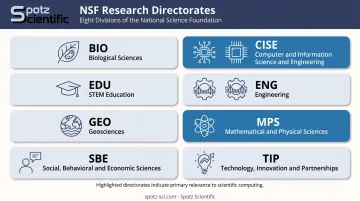
Within each directorate are divisions; within each division are individual programs. A proposal is submitted to a specific program, and the program manager (also called program director) is the frontline decision-maker who assesses fit, assembles external reviews, and manages the portfolio.
CISE: The Home for Scientific Computing Research
For researchers in scientific computing, applied mathematics, and data science, CISE is the primary destination. Its four units are:
- Computing and Communication Foundations (CCF)
- Computer and Network Systems (CNS)
- Information and Intelligent Systems (IIS)
- Office of Advanced Cyberinfrastructure (OAC) — covers high-performance computing, data systems, software, and shared cyberinfrastructure
Spotz Scientific focuses specifically on NSF CISE proposals, alongside DOE ASCR, the two agencies where computational science research primarily lives.
The Rotator System
Most NSF program managers are "rotators" — researchers from universities and national labs serving one- to two-year stints at the agency through Intergovernmental Personnel Act appointments. They bring domain expertise and an academic researcher's perspective to the review process.
Contacting a program manager before submission is not just permitted — NSF explicitly encourages it. A focused email can confirm whether your project fits the program or redirect you to a better-matched opportunity, including crosscutting programs you may not have known existed.
How NSF Funds Research: Mechanisms and Award Types
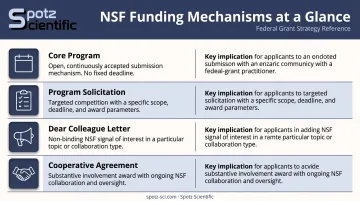
NSF uses four distinct funding mechanisms, and which one applies to your proposal determines the rules you follow — the deadline format, eligibility constraints, and submission requirements all vary by mechanism:
| Mechanism | What It Is | What It Means for You |
|---|---|---|
| Core program | Open, ongoing call under standard PAPPG rules | Submit when your project fits a standing disciplinary portfolio |
| Program solicitation | Focused competition with specific requirements | Follow its eligibility, format, and deadline rules exactly — they can supersede the PAPPG |
| Dear Colleague Letter (DCL) | Signals interest in a topic; routes through existing programs | Trace the DCL to the actual program that accepts proposals |
| Cooperative agreement | Used when NSF expects ongoing agency involvement | Expect closer coordination than a standard grant |
Award Types and Competitive Landscape
In FY2024, NSF evaluated approximately 40,000 proposals, made roughly 11,000 competitive awards, and reported an agency-wide 26% funding rate. The average competitive award was approximately $256,000 annually. By directorate, the FY2023 mean annualized research award was:
- BIO: $288K | CISE: $238K | ENG: $174K | MPS: $170K
Standard grants typically run one to five years. Most investigators should plan for a three-year average. For large collaborative efforts or facility projects, cooperative agreements apply.
Beyond these standard timelines, some structured programs operate by entirely different rules. The NSF CAREER award, GRFP, and the (currently archived) CISE Research Initiation Initiative (CRII) each have specific eligibility windows and submission requirements that differ significantly from investigator-initiated calls. Check the live solicitation page before assuming you know the eligibility rules or deadlines.
One step many researchers miss: some solicitations require a letter of intent or preliminary proposal before the full submission. Missing this step disqualifies an application before review begins. Read every solicitation fully before building your timeline.
The NSF Merit Review Process
The Two Criteria That Decide Everything
NSF's Proposal and Award Policies and Procedures Guide (PAPPG) defines the two mandatory review criteria:
- Intellectual Merit — the potential to advance knowledge within and across fields
- Broader Impacts — the potential to benefit society and contribute to desired societal outcomes
Both criteria carry equal weight. Proposals that neglect either (even those with excellent science) are routinely ranked lower. Broader Impacts is not an appendix to fill in at the end; it is half the evaluation.
Reviewers also assess whether a proposal suggests creative, original, or potentially transformative concepts. NSF explicitly values bold ideas that could shift paradigms, not just incremental work. Communicating transformative potential requires specific, deliberate language choices in your project description rather than simply asserting the work is novel.
How Review Actually Works
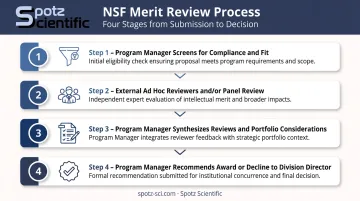
The mechanics:
- Program manager screens for compliance and fit
- Proposal goes to ad hoc external reviewers, a panel, or both
- Program manager synthesizes reviews and portfolio considerations
- Program manager recommends award or decline to the division director
Proposers receive written reviews and a panel summary after the decision. Reviewer identities are protected. NSF aims to notify proposers within six months of the deadline, though this varies.
Portfolio balance matters more than most applicants realize. A program manager building a portfolio considers geographic distribution, career stage, methodological diversity, and thematic coverage — not just raw rankings. A technically strong proposal can be declined for portfolio reasons; a good fit with the program and a distinctive angle increases your odds beyond the score alone.
The Value of a Pre-Submission Red Team Review
Researchers who have never submitted to NSF (and many who have) benefit from a critical pre-submission read by someone familiar with how panels actually evaluate proposals. An internal colleague will rarely tell you that your Broader Impacts section is thin or that your framing signals the wrong program. A red team reviewer will.
Spotz Scientific's red team review service addresses exactly this need. Dr. Bill Spotz evaluates draft proposals from a program manager's perspective, identifying weaknesses in scientific framing, Broader Impacts narratives, and program alignment before they reach reviewers — the same stage where funding decisions are actually shaped.
Key NSF Programs for Scientific Computing Researchers
Flagship Programs to Know
NSF CAREER Program The Faculty Early Career Development Program is NSF's premier early-career award. Key requirements at a glance:
- Tenure-track assistant professor position (at least 50% appointment, untenured at the deadline)
- Five-year project integrating research and education
- Minimum budget of $400K ($500K for BIO, ENG, and OPP)
- Next listed deadline: July 22, 2026
CAREER proposals require a strong educational component. Weak education plans are a consistent cause of lower rankings — reviewers take this seriously.
Spotz Scientific provides dedicated CAREER consulting: proposal strategy, red team review of drafts, and alignment with NSF CISE priorities.
NSF Graduate Research Fellowship Program (GRFP) GRFP supports U.S. citizens and permanent residents in research-based graduate study. Key facts:
- Three years of support within a five-year fellowship period
- Current solicitation (NSF 25-547) values each fellowship at $159K
- Field-specific 2025 deadlines have passed; check the live solicitation for 2026 windows
Office of Advanced Cyberinfrastructure (OAC) Within CISE, OAC funds research, software, campus infrastructure, and national cyberinfrastructure. If your work involves high-performance computing platforms, data systems, or shared research software, OAC programs belong on your list alongside core CISE research programs.
Tracking Crosscutting Priorities
NSF's priority investments shift. Recent DCLs and solicitations have signaled interest in:
- Quantum information science and engineering (ENG DCL NSF 24-042)
- Microelectronics and semiconductors (ENG DCL NSF 24-038)
- Open-source software ecosystems (POSE solicitation NSF 23-556)
- U.S.-UK AI and quantum center collaboration (September 2025 DCL)
Monitoring Dear Colleague Letters is the best way to track these priorities before formal solicitations appear. A DCL is an early signal; the program or solicitation it references is where the actual proposal goes.
That cross-directorate awareness also applies to your program search. A computational scientist whose methods address biological, geoscientific, or social questions may find relevant programs across BIO, GEO, SBE, and MPS, not just CISE.
How to Navigate NSF Funding Successfully
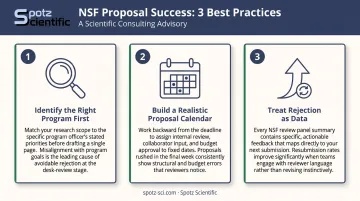
Three practices separate researchers who succeed at NSF from those who don't:
Identify the right program before writing anything. Read program descriptions carefully, then search NSF's public award database to see what has actually been funded there recently. If fit is unclear — especially for interdisciplinary work spanning CISE, MPS, ENG, and TIP — email the cognizant program manager. NSF actively encourages this contact. Program managers can confirm fit, point you to a better program, or flag a crosscutting opportunity you may not have seen.
Build a realistic proposal calendar. Missing a deadline by a single day means waiting a full cycle — and a competitive NSF submission takes months to prepare, not weeks. Build in time for institutional budget review, Sponsored Programs Office processing, and at least one serious round of revision. Engaging a proposal consultant at least two weeks before the deadline — ideally much earlier for complex programs like CAREER — allows time for strategic advisory work and meaningful draft improvement.
Treat a rejection as data. NSF provides written reviewer feedback on every declined proposal. A submission with strong reviews that is substantially revised and resubmitted often scores markedly higher the second time. NSF treats resubmissions as new proposals — they must comply with the current PAPPG and solicitation, and reviewers should not be able to identify the submission as a revision. Researchers who read that feedback honestly, revise accordingly, and resubmit are the ones who eventually get funded.
Frequently Asked Questions
What is an NSF program?
An NSF program is a specific funding area within a directorate and division with a defined scientific scope, budget, and review process. Researchers submit proposals to a specific program, and a program manager oversees the competition and manages the portfolio of funded awards within it.
Who is eligible for NSF grants?
Most NSF research grants are available to U.S.-based institutions — universities, colleges, non-profits, and some federal facilities. Individual eligibility varies by program: GRFP and CAREER have career-stage requirements, while core research programs are open to investigators at any stage as long as their institution qualifies.
What types of funding does NSF offer?
NSF offers standard grants, continuing grants, cooperative agreements, and fellowships. Awards range from small early-career initiation grants to large center grants. Both individual investigators and collaborative teams can apply, depending on the program.
Is NSF still funding projects?
NSF's funding landscape has shifted under recent federal policy changes. Some programs and directorates remain active; others have seen disruption. Check the current status of any program directly on the NSF website before spending time on a proposal.
How does the NSF merit review process work?
NSF evaluates proposals on Intellectual Merit and Broader Impacts using external peer reviewers and panels. Program managers then make final funding decisions based on reviewer rankings and portfolio considerations. The process typically runs six months from submission to decision.
What is the NSF CAREER program?
The Faculty Early Career Development (CAREER) program is NSF's most prestigious early-career award. It supports pre-tenure faculty who integrate research and education, requires a five-year project with a strong educational component, and is among the most competitive awards NSF offers. Minimum budgets are $400K–$500K depending on directorate.