Key Takeaways
- SBIR is a non-dilutive federal funding program awarding nearly $4B annually to small businesses across 11 agencies
- Eligibility requires ≤500 employees, U.S. ownership >50%, and a PI primarily employed by the applicant
- Three phases structure the funding path: Phase I feasibility ($200K–$323K), Phase II full R&D ($1.1M–$2.15M), and Phase III commercialization
- Agency and topic fit matters as much as technical quality — misalignment is the leading reason strong proposals get rejected
- SBIR competitions are selective; understanding review criteria and agency priorities before writing gives applicants a real edge
Introduction
Many research teams hit the same wall: a genuinely promising innovation, no clear path to federal funding, and no appetite to give up equity or spend months courting venture capital. SBIR exists precisely for this situation.
The Small Business Innovation Research program is the U.S. government's primary mechanism for channeling early-stage R&D funding to small businesses. Established by the Small Business Innovation Development Act of 1982, it now distributes close to $4 billion annually across 11 participating federal agencies. For early-stage companies, it's one of the most significant non-dilutive funding sources available.
This guide covers what you actually need to know to compete:
- Eligibility rules and ownership requirements
- How the three funding phases work in practice
- Which agency fits your research area
- How to submit a competitive application
- What consistently separates funded proposals from rejected ones
What Is the SBIR Program?
SBIR is a congressionally mandated competitive program that requires federal agencies with large external R&D budgets to reserve a percentage of those funds for small businesses. The SBA coordinates the program, issues policy directives, and reports to Congress — but participating agencies make the awards.
The program's core goals:
- Stimulate technological innovation in the private sector
- Use small businesses to meet federal R&D needs
- Foster participation from undercapitalized companies
- Increase private-sector commercialization of federally funded innovations
Not a Loan, Not a Traditional Grant
SBIR funding is neither a loan nor a conventional single-instrument grant. Agencies award funds through contracts, grants, cooperative agreements, or other transaction agreements depending on the agency. What every instrument shares: recipients surrender no equity, making SBIR an explicitly non-dilutive capital source.
Per FY2022 SBA data, SBIR obligations across all agencies totaled $4.116 billion. A GAO analysis of FY2023 data puts SBIR-specific new awards at approximately $3.95 billion across roughly 5,262 awards (calculated by subtracting STTR figures from combined program totals).
Who Qualifies for SBIR Funding?
Eligibility is defined at the SBA level, but the rules have real teeth. All three requirements below must be met simultaneously.
The Three Core Requirements
| Requirement | Rule |
|---|---|
| Business type | Must be a for-profit U.S.-based company |
| Size | Applicant plus all affiliates must have 500 or fewer employees (full-time, part-time, and other-basis combined) |
| Location | Must be primarily located in the United States or its territories |
Ownership and Control
More than 50% of the company must be owned and controlled by U.S. citizens or permanent resident aliens, or by other small businesses that themselves meet this ownership test. Exceptions exist for firms majority-owned by multiple U.S.-organized venture capital operating companies, hedge funds, or private equity firms, provided no single investor holds more than 50% control.
Verify current SBA rules at sbir.gov since ownership exception details can shift.
The Principal Investigator Rule
The PI leading the research must be primarily employed by the applying small business for the duration of the award — with no full-time position elsewhere and generally no more than 19.6 hours per week at any other organization. A tenured professor who consults on the side does not meet this requirement for SBIR. This is a hard eligibility gate, not a scoring factor.
Understanding the Three Phases of SBIR Funding
The three-phase structure funds innovation in stages. Agencies invest incrementally — testing feasibility first, then supporting full R&D, then stepping back as the company pursues commercialization. Each phase has distinct goals, timelines, and funding levels that vary by agency.
Phase I: Establishing Feasibility
Phase I tests whether the core idea has scientific and technical merit and commercial potential. The goal is not a finished product — it's demonstrated feasibility. Typical duration runs six months to two years, depending on the agency.
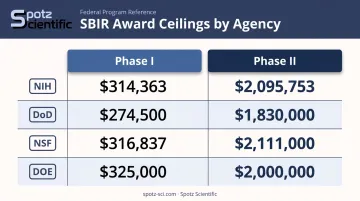
Current Phase I award ceilings by agency:
- NIH: up to $323,090
- DoD: up to $323,090 (general cap; component values vary)
- NSF: up to $305,000
- DOE: up to $200,000
Phase II: Full Research and Development
Phase II builds directly on Phase I results. This is where prototype development and substantive R&D happens. Most Phase II awards run up to 24 months, though NIH allows up to three years.
Current Phase II award ceilings by agency:
- NIH: up to $2,153,927
- DoD: up to $2,153,927 (general cap)
- NSF: up to $1,250,000
- DOE: up to $1.1M–$1.6M depending on topic
Some agencies offer extensions: NIH has Phase IIB and commercialization-readiness supplements, DOE offers Phase IIA/IIB continuation awards and a Phase IIC requiring a 1:1 non-SBIR investor match, and NSF offers Phase IIB matching supplements.
Phase III: Commercialization
Phase III receives no SBIR set-aside funds. The program's logic is that successful Phase I and II work should position the company to pursue commercialization through private investment, non-SBIR government contracts, or other non-federal sources. Completing Phases I and II provides government-backed validation that investors and procurement officers recognize when evaluating the technology.
Fast-Track and Direct-to-Phase II Options
Some agencies offer alternative application paths:
- Fast-Track: Submit Phase I and Phase II together in one application to reduce the funding gap between phases. NSF launched a Fast-Track pilot in July 2024 offering up to $1.555M combined. DOE and DoD also offer topic-dependent Fast-Track options.
- Direct-to-Phase II: Available at NIH and DoD when feasibility has already been demonstrated without a prior SBIR award. NSF does not currently offer this path.
Availability and requirements vary significantly by agency — confirm with the specific program before planning around these options.
How to Choose the Right Federal Agency for Your SBIR Proposal
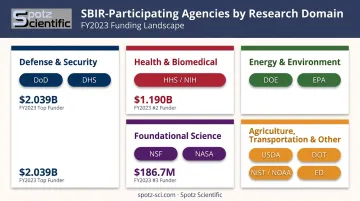
Eleven agencies participate in SBIR, each reserving at least 3.2% of their extramural R&D budget for small businesses. The 11 participants are: USDA, DOC, DoD, DOE, HHS, DHS, DOT, ED, EPA, NASA, and NSF.
Choosing the right agency is not a minor administrative decision. Proposals must align with a specific agency's mission and an advertised solicitation topic — technical strength alone doesn't overcome poor fit.
Agency Groups by Research Domain
| Domain | Agencies |
|---|---|
| Defense and Security | DoD, DHS |
| Health and Biomedical | HHS (including NIH) |
| Energy and Environment | DOE, EPA |
| Foundational Science and Engineering | NSF, NASA |
| Agriculture, Transportation, Education, Commerce | USDA, DOT, NIST/NOAA, Dept. of Education |
The three largest funders by FY2023 SBIR awards: DoD ($2.039B, 2,574 awards), HHS ($1.190B, 1,149 awards), and NSF ($186.7M, 357 awards), per GAO FY2023 data.
For Computational and Scientific Computing Teams
If your work sits in applied mathematics, high-performance computing, scientific machine learning, or data-intensive scientific workflows, two agencies consistently publish the most relevant solicitation topics:
DOE Office of Science (ASCR): The FY2025 Phase I solicitation includes ASCR topic C59-01, Accelerating the Deployment of Advanced Software Technologies, covering HPC software, mathematical libraries, compilers, runtimes, MPI, AI integration, and quantum software — along with C59-02 covering HPC cybersecurity. These topics don't appear prominently in DoD or NIH solicitations.
NSF SBIR: NSF publishes dedicated topic areas for Artificial Intelligence and Advanced Systems for Scalable Analytics, making it a strong fit for data-focused computational research.
Spotz Scientific's SBIR consulting focuses on precisely this space. Founder Bill Spotz spent eight years as a program manager at DOE's ASCR office, co-leading the applied mathematics program and managing over $264 million in scientific computing research — giving him direct experience with how these submissions are evaluated.
How to Apply for SBIR Funding: A Step-by-Step Guide
Step 1 — Identify the Right Solicitation
SBIR.gov is the central portal for all participating agency topics. Read topic descriptions thoroughly — strong proposals directly address the specific problem an agency has articulated, not just a related area. Treating a solicitation topic as a general invitation rather than a precise brief will cost you reviewer confidence fast.
Step 2 — Complete Required Registrations Early
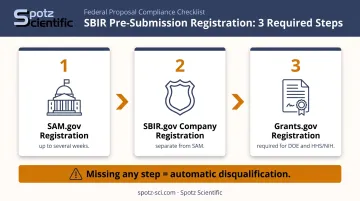
Three registrations are mandatory before submission:
- SAM.gov — required for all federal awards; activation can take up to 10 business days, though SBIR.gov warns the full process can take several weeks
- SBIR.gov company registration — required separately from SAM
- Grants.gov — required for grant-making agencies including DOE and HHS/NIH
Missing a registration deadline disqualifies an otherwise strong application. Start this process the moment you identify a target solicitation.
Step 3 — Contact the Program Officer Before Submitting
Most agencies encourage pre-submission contact — and the policies differ enough to matter:
- DoD: Contact topic authors during the pre-release window; contact is prohibited once the solicitation opens
- NIH: Strongly encourages contact for budget requests above published guidelines
- NSF: Maintains contact channels and office hours throughout the process
First-time applicants routinely skip this step, which is a costly mistake. A brief conversation with a program officer can confirm whether your idea fits the topic and surface guidance that saves weeks of misdirected writing.
Step 4 — Build the Three Core Proposal Components
- Technical proposal: Scientific merit, approach, innovation, feasibility, and team qualifications
- Commercialization plan: Specific customer identification, credible path from R&D to market, revenue strategy, and post-award thinking
- Cost proposal: A detailed, justified budget where every line item connects to a specific research task — not a round-number estimate
Step 5 — Understand the Review Timeline
There is no single universal timeline. Based on published agency data:
- NSF: Approximately six months from full proposal submission to funding notification
- DoD: Selection notice within 90 days; contracting contact typically follows in four to six weeks
- DOE: Round-specific dates — FY2026 Release 1, for example, had an October submission deadline with January notification and a February projected start
- NIH: Standard due dates of September 5, January 5, and April 5, with corresponding starts in April, July, and September/December
That waiting period isn't dead time. Use it to begin Phase II groundwork, cultivate commercialization relationships, or explore complementary funding sources.
What Makes a Winning SBIR Proposal?
Solicitation Alignment Comes First
The most common reason technically strong proposals get rejected is misalignment between the proposal and the agency's stated topic. Reviewers score against specific criteria, and a sophisticated proposal that doesn't directly address the solicitation's research problem will consistently score below a well-matched but less sophisticated one.
Read the solicitation as a brief, not a suggestion. The agency has identified a specific problem it needs solved. Your proposal should answer that problem directly.
A Commercialization Plan Reviewers Take Seriously
Weak commercialization sections are among the most cited reasons for low scores, even when the technical approach is strong. A competitive plan:
- Names a specific customer, not a broad market category
- Articulates a credible path from R&D output to a deployable product or service
- Shows the team has thought beyond the award itself
- Demonstrates market awareness and a realistic revenue path
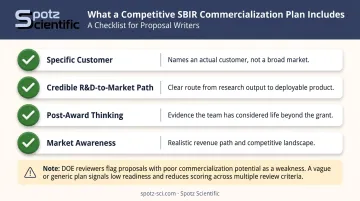
For DOE specifically, the FY2025 NOFO states that Fast-Track applications with poor commercialization potential will not be funded — and weaknesses in any of the three merit criteria can preclude an award entirely.
The Value of Red Team Review
Having experts who understand how federal program managers evaluate proposals review a draft before submission surfaces gaps that internal review consistently misses: gaps in scientific framing, commercialization logic, and budget justification.
For teams targeting DOE ASCR or NSF solicitations, this is where having a reviewer with experience on the program manager's side of the table matters. Knowing what a program manager is actually looking for — when reading a commercialization plan or assessing technical merit — differs from simply knowing what the written criteria say. That insider perspective is what Spotz Scientific's red team review service draws on, built from Bill Spotz's years evaluating proposals from inside DOE ASCR.
Write for the Whole Review Panel
Federal review panels include both domain specialists and generalists. Proposals dense with unexplained jargon score poorly with generalist panelists, which drags down overall scores. Each major agency structures its panels differently:
- NSF uses reviewers with both technical and commercial experience
- NIH convenes temporary experts on special-emphasis panels
- DOE may use government and qualified non-federal experts
The practical rule: if a sharp scientist outside your exact subfield can't follow your argument, your proposal has a problem.
Frequently Asked Questions
Are SBIR grants still available?
Yes. SBIR is active and ongoing. Public Law 119-83, enacted April 13, 2026, reauthorizes the program through September 30, 2031. Federal agencies issue new solicitations on a rolling or annual basis. Check SBIR.gov for currently open opportunities.
Are SBIR grants hard to get?
The program is competitive. FY2022 SBA data shows a program-wide Phase I selection rate of 16% (ranging from 11% at NSF to 19% at DOE), with NIH trending lower at 10% in FY2024 and 8% in FY2025 per NIH Data Book figures. Success rates improve with strong solicitation alignment, a credible commercialization plan, and experienced proposal review.
What is the difference between SBIR and STTR?
STTR (Small Business Technology Transfer) requires a formal partnership with a nonprofit research institution such as a university. The small business must perform at least 40% of the R&D work and the partner institution at least 30%. SBIR has no mandatory institutional partner. STTR is the right vehicle when university collaboration is structurally central to the project.
Can a small business apply to multiple SBIR agencies at the same time?
Yes, simultaneous submissions to multiple agencies are permitted — provided each proposal responds to that specific agency's solicitation topic and the projects are distinct. Submitting substantially equivalent work to multiple agencies without disclosure is not permitted; duplicate federal funding for the same work is prohibited.
Do SBIR award recipients keep their intellectual property?
Generally yes. Under the Bayh-Dole Act, small businesses may retain title to inventions developed under SBIR awards, and technical data receives a 20-year protection period, each subject to reporting obligations and defined government license rights. Patent rights and SBIR data rights are legally distinct, so consult a qualified attorney for your specific situation.
How long does it take to receive an SBIR award after submitting?
It depends on the agency. NSF targets approximately six months from submission to notification. DoD publishes a 90-day selection target with contracting contact following in four to six weeks. DOE publishes round-specific dates. Budget accordingly and don't assume a universal timeline applies to your target agency.