
This guide walks through the federal scientific grant review process step by step — the criteria reviewers score against, what separates funded proposals from strong-but-unfunded ones, and the most avoidable mistakes that hurt scores.
Key Takeaways
- Reading the review rubric before you write is your single biggest competitive advantage
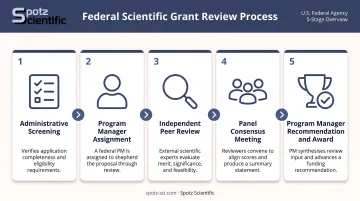
- Federal reviews run through four stages — administrative screening, peer review, panel consensus, and program manager recommendation — and each one can eliminate your proposal
- Excellent science outside program priorities won't get funded. NOFO alignment matters as much as the research itself.
- Program managers hold real discretion over final awards — panel scores are a recommendation, not a decision
- Most funded proposals were rejected at least once. Treat reviewer feedback as a revision blueprint, not a final judgment.
What Does Grant Proposal Review Mean?
Grant proposal review is the formal, scored process by which a funding agency evaluates submitted proposals for scientific merit, programmatic relevance, and feasibility before making award decisions. The process is structured and scored, with multiple decision-makers each operating against defined criteria.
At federal agencies like DOE Office of Science and NSF, the process is governed by specific policies. DOE operates under its Merit Review System (10 CFR Part 605), while NSF's review framework is defined in PAPPG 24-1, with NSF's two formal criteria — Intellectual Merit and Broader Impacts — established by the National Science Board.
What this means in practice: reviewers assess your proposal across three dimensions at once — scientific quality, fit with program priorities, and execution feasibility. A proposal that excels on one but neglects the others is unlikely to survive panel review.
How Federal Scientific Grant Proposals Are Reviewed: Step by Step
Understanding the sequence helps you anticipate what happens to your proposal after submission — and what each stage demands from your document.
Step 1: Administrative and Compliance Screening
Before any scientific evaluation begins, agency staff verify that the proposal meets basic submission requirements: page limits, required sections, formatting rules, and eligibility criteria.
Proposals failing this stage are rejected without review, regardless of scientific quality. NSF's FY 2018 Merit Review Process Digest reported 1,101 proposals returned without review — 2.3% of all proposal decisions that year. Effective December 8, 2025, NSF added an explicit trigger: proposals without sufficient content for effective merit review can now be returned without review under PAPPG Supplement 1.
DOE similarly allows proposals deemed inadequate for detailed evaluation to be declined without review.
Step 2: Assignment to Program Manager and Review Panel
Accepted proposals are assigned to a program manager (DOE) or program officer (NSF) who matches the submission to an appropriate review panel based on topic area. At DOE ASCR and NSF CISE, this person plays a critical role throughout the entire process — not just at the end.
Researchers can and should identify the relevant program manager early and reach out before submission. A brief contact confirming fit with the program's current priorities is appropriate and often valuable. Published NOFOs typically identify program managers by name and contact.
Step 3: Independent Peer Review and Scoring
Individual reviewers read and score proposals independently against the agency's stated criteria, producing written critiques and numerical scores. DOE's Merit Review System requires at least three qualified reviewers. NSF typically uses three to ten external reviewers depending on the mechanism.
Reviewers are working through a large stack of proposals in a compressed window — DOE mail reviews typically allow approximately six weeks. Clarity and organization aren't stylistic preferences. They're functional requirements for getting a fair read under time pressure.
Step 4: Panel Consensus Meeting
Reviewers convene — now typically via virtual panel at ASCR — to discuss scores, reconcile differences, and arrive at a consensus evaluation. This step matters more than most researchers realize.
Proposals that are easy to champion in discussion fare better than those reviewers can't clearly articulate a case for. A reviewer who liked your proposal needs to be able to explain why to colleagues who may have scored it lower. If your proposal's core contribution isn't memorable and quotable, that advocacy becomes difficult.
Step 5: Program Manager Recommendation and Final Award Decision
Panel scores are advisory, not binding. The program manager synthesizes panel input alongside several additional factors before making a final recommendation:
- Strategic program priorities and current research directions
- Portfolio balance across institutions, methods, and research areas
- Available funding for the cycle
NSF explicitly states that a proposal does not need all "Excellent" scores to be funded — and all "Excellent" scores don't guarantee funding. DOE's process works the same way: selection officials weigh merit-review findings against program policy factors, including relevance to Office of Science priorities and portfolio balance.
This is why understanding the specific funding opportunity — not just the agency's general mission — is essential.
Key Criteria Used to Evaluate Scientific Grant Proposals
While criteria vary by program, federal scientific reviews at DOE and NSF consistently assess proposals across several core dimensions. Knowing these criteria before you write is the single most important preparation step.
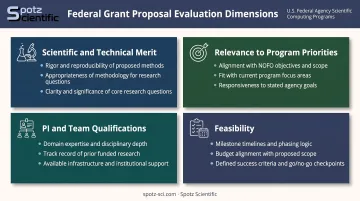
Scientific and Technical Merit
Reviewers assess the intellectual rigor of the proposed approach: Is the science sound? Is the methodology appropriate? Are the research questions well-posed?
DOE's criteria under 10 CFR Part 605 list scientific and technical merit first, followed by appropriateness of method or approach. NSF frames this as Intellectual Merit: the potential to advance knowledge.
Vague or overreaching technical claims are a common score-reducer in computational science proposals, where reviewers expect precise problem definitions and concrete methodological commitments.
Relevance to Program Priorities
Scientific excellence alone is not sufficient. A proposal addressing a topic outside the program's current focus will score poorly on relevance even if technical merit is high.
Treat the NOFO as a scoring document. Every stated priority is a signal about what reviewers will be checking. Read it multiple times. Map your proposal's contributions directly to the language the program uses — not just thematically, but explicitly.
Qualifications of the PI and Research Team
Reviewers assess whether the team has the expertise, track record, and infrastructure to execute the proposed work.
Early-career programs apply modified criteria. Both the DOE Early Career Research Program (DE-FOA-0003602, with ~100 expected awards and $145 million in anticipated FY2026 funding) and the NSF CAREER program place greater emphasis on research potential and the quality of the research environment — not just prior output.
Feasibility: Workplan, Timeline, and Budget
A realistic, well-scoped workplan signals that the PI understands how to execute — not just how to conceive. Key elements reviewers look for:
- Milestone-based timelines with concrete deliverables at defined intervals
- Budget alignment with proposed scope — both inflated and insufficient budgets raise credibility questions
- Clearly defined success criteria for each phase of the work
DOE's formal criteria explicitly include competency of personnel, adequacy of resources, and reasonableness of budget as separate evaluation dimensions.
Broader Impacts and Significance
NSF's Broader Impacts criterion carries formal scoring weight and requires explicit articulation of how the work will contribute to desired societal outcomes. DOE programs frame this around energy mission relevance or computational infrastructure benefit. Either way, reviewers want a direct, specific answer to the same question: why does this work matter beyond the lab?
What Separates Funded Proposals from the Rest
Many proposals score well on individual criteria but still don't get funded. NSF's FY 2023 Merit Review Digest reported more than 3,900 declined proposals with scores at least as high as the average awarded proposal, and more than 200 rated "Excellent" that received no award. NSF CISE's FY 2024 funding rate was 22% overall, with IIS at just 15%.
The difference often lies in factors that aren't explicit in the rubric. Three patterns consistently separate competitive proposals from the rest.
Write for the reviewer, not the discipline. The strongest proposals anticipate reviewer objections, define technical terms non-specialists may not know, and make the case for funding explicitly. Proposals that read like academic papers frequently underperform in panel settings where reviewers have mixed expertise.
Demonstrate strategic alignment. Knowing the program's current portfolio gaps and showing how your work fills them is different from simply addressing the NOFO's stated topics. Researching recent awards reveals what the program manager is actively building toward — and that context shapes how you frame your contributions.
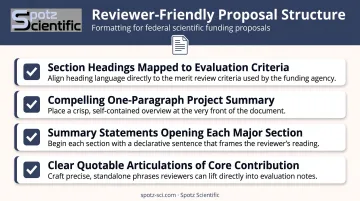
Reviewer-Friendly Presentation
Specific formatting choices help reviewers advocate for your proposal in the consensus meeting:
- Section headings that map directly to evaluation criteria
- A compelling one-paragraph project summary at the front
- Summary statements at the start of each major section
- Clear, quotable articulations of the core contribution
Consider a red team review before submission. Researchers preparing high-stakes applications — especially DOE Early Career or NSF CAREER proposals — benefit from having experienced reviewers score a draft using the actual criteria before submission. Spotz Scientific offers this service, drawing on Bill Spotz's direct program management experience at DOE ASCR. It's among the most direct ways to approximate the panel experience before it counts.
Common Mistakes That Hurt Your Score
Writing to the Science Instead of the Program
Proposals that focus entirely on technical novelty without explicitly connecting to the NOFO's stated priorities leave reviewers to make the connection themselves. Reviewers evaluating 20+ proposals under time pressure won't do that interpretive work for you. Your alignment with program goals needs to be stated, not assumed.
Burying the Key Message
Proposals with weak executive summaries or project descriptions that take two pages to reach the central research question create a first impression that's hard to recover from. Reviewers form impressions early. Front-loading your value proposition — what you're doing, why it matters to this program, and what qualifies your team — is not redundant with later sections. It sets the frame reviewers carry through the rest of the proposal.
Vague Evaluation Frameworks
Work plans that describe activities but not outcomes, and proposals with no measurable success criteria, signal execution uncertainty. For computational science proposals specifically, common gaps include:
- No defined performance metrics or benchmarks
- No described validation approaches
- Deliverables listed without specificity (e.g., "a scalable solver" vs. "a solver demonstrating X% improvement on Y benchmark problem class")
Reviewers scoring feasibility need concrete anchors. Without them, even strong science reads as speculative.
Frequently Asked Questions
What does grant proposal review mean?
Grant proposal review is the formal process by which a funding agency evaluates submitted proposals for scientific merit, programmatic fit, and feasibility through independent peer reviewers, expert panels, and program staff before making award decisions. It's a scored, multi-stage evaluation, not informal commentary.
How long does the grant review process take?
NSF aims to inform applicants of funding decisions within six months of submission. DOE Office of Science typically completes reviews within 6 to 12 months of receipt. Timelines vary by program and submission volume, so check the specific NOFO for expected decision dates.
What are the 5 R's of grant writing?
The 5 R's (typically: Relevance, Rationale, Research plan, Resources, and Results/Return) are a proposal-organization mnemonic from the grant-writing community. Each maps to criteria reviewers formally score, making them useful for checklist purposes — but not a substitute for reading the actual evaluation criteria in your NOFO.
What criteria do DOE and NSF reviewers use to evaluate scientific proposals?
DOE's Merit Review System (10 CFR Part 605) assesses scientific/technical merit, appropriateness of method, personnel competency, budget reasonableness, and solicitation-specific factors. NSF uses Intellectual Merit and Broader Impacts. Both agencies weight criteria differently by program. Always consult the specific NOFO for exact criteria and their relative importance.
What is the difference between scientific merit and program relevance?
Scientific merit refers to the quality and rigor of the proposed research itself : whether the science is sound and the methodology appropriate. Program relevance assesses whether the work aligns with the funding program's specific current priorities. Both are required for a competitive proposal; strong merit with weak relevance rarely gets funded.
How can I improve my proposal based on reviewer feedback?
Request written reviewer critiques when available, as most agencies provide them. Map each comment to the specific evaluation criterion it addresses and treat the feedback as a resubmission blueprint. Most funded proposals are not first-round submissions — a well-addressed resubmission signals maturity and responsiveness to the program.