Introduction
A grant proposal is a persuasive argument for why your work deserves public money over someone else's, not merely a description of your project. Reviewers at federal agencies often spend only a limited window per submission, scanning for clarity, alignment, and red flags before they ever get to the technical merit.
For scientific computing researchers, the stakes are higher. Technical reviewers at DOE's Advanced Scientific Computing Research (ASCR) program or NSF's Computer and Information Science and Engineering (CISE) directorate expect precision, exact formatting, and direct alignment with stated program priorities. Generic narratives get spotted fast.
This guide breaks down the universal architecture every grant proposal shares, then covers what changes when you're writing for federal scientific funding agencies specifically.
Key Takeaways
- A competitive proposal builds one continuous argument connecting need, goals, methods, and budget
- Following the funder's exact structure matters more than any generic proposal template
- DOE and NSF proposals typically require extras like biosketches, data plans, and Broader Impacts statements
- An outside expert review before submission catches gaps internal teams routinely miss
Before You Write: Laying the Groundwork
Before drafting a single sentence, research the funding agency's mission and read the specific Notice of Funding Opportunity (NOFO) or solicitation in full. Your narrative needs to mirror the funder's stated priorities, not just describe good science.
Read the solicitation multiple times. Note every mandatory section, page or character limit, and formatting rule. Deviations from these instructions frequently cause administrative rejection before a technical reviewer ever opens the file.
Practical prep steps to complete early:
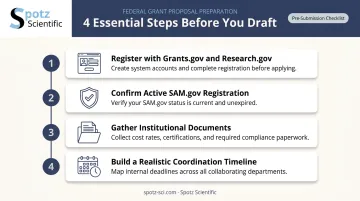
- Register your organization with Grants.gov and NSF's Research.gov well ahead of any deadline
- Confirm an active SAM.gov registration; activation typically takes up to 10 business days but Grants.gov notes it can stretch to weeks or months if information doesn't validate cleanly
- Gather institutional documents (indirect cost rates, facilities data, compliance certifications) before you need them
- Build a realistic internal timeline, since complex federal proposals demand substantial coordination across PIs, co-PIs, and sponsored programs offices
Strategic interpretation matters here, too. Understanding what a program office actually wants, beyond the literal solicitation text, takes insight gained from sitting on the other side of the review table. That firsthand perspective is what Spotz Scientific's Strategic NOFO Advisory service provides.
The Essential Structure of a Grant Proposal
Funders label sections differently, but nearly every proposal follows the same core architecture. Following each funder's exact required order and headings isn't optional. It's the first thing an administrative reviewer checks.
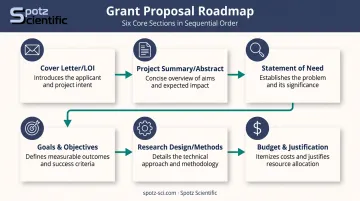
Cover Letter or Letter of Intent
A cover letter is a short, professional introduction confirming eligibility, program fit, and the amount requested. Some agencies require a separate Letter of Intent (LOI) well before the full proposal deadline. NSF's 2022 CISE Research Visioning solicitation, for example, required an LOI 148 days ahead of the full proposal.
Quick rules:
- Keep it under one page
- Reference the solicitation or opportunity number directly
- Don't repeat your full narrative here
Project Summary or Abstract
This is often the only section every reviewer reads in full. NSF requires it to fit on one page, with three distinct parts: an overview, an Intellectual Merit statement, and a Broader Impacts statement, each addressed separately per the current PAPPG.
State the problem, your approach, and expected outcomes concisely. Map directly to the required review criteria; don't make reviewers hunt for how you address them.
Statement of Need or Significance
Establish the problem using credible, recent, field-specific data. Identify a genuine gap in current knowledge or capability, not a vague statement that "more research is needed."
For research proposals, this typically takes the form of a compact literature review that demonstrates command of the state of the art and shows precisely how your proposed work advances it.
Goals, Objectives, and Specific Aims
Separate broad goals from measurable, time-bound objectives:
- Goal: Advance scalable algorithms for exascale climate simulation
- Objective: Reduce solver runtime by 30% on target architecture within 24 months
Aims must connect logically to the methods and evaluation sections that follow. Reviewers actively check this throughline, and a broken connection between what you promise and how you'll measure it is an easy point of criticism.
Research Design, Methods, or Approach
This is the technical core of a scientific proposal. It needs:
- Describe your detailed methodology and approach
- Outline computational resources and infrastructure plans
- Define your validation strategy
- Specify expected deliverables and milestones
Address feasibility and risk mitigation proactively. Anticipate the technical questions a reviewer is likely to raise, and answer them before they're asked.
Budget and Budget Justification
Standard categories include personnel, travel, equipment, and indirect costs. NSF mandates a budget justification of up to five pages that documents and justifies every line item, with a separate justification for each subaward.
Every figure needs a narrative explanation tied directly to project activities. A budget that doesn't match the scale of work described in the narrative is one of the fastest ways to raise doubt about whether you've thought the project through.
What Makes Federal Scientific Computing Proposals Different (DOE & NSF Specifics)
Federal scientific computing proposals carry structural requirements that generic templates simply don't cover.
NSF's dual review criteria. Intellectual Merit and Broader Impacts must run through the entire narrative, not just sit in the project summary. Reviewers expect to see both woven into your methods, your team composition, and your outcomes.
DOE's program alignment requirement. ASCR proposals must explicitly align with priorities named in the specific Funding Opportunity Announcement and show awareness of the program office's ongoing research portfolio.
DOE's own ASCR guidance points applicants toward prior award abstracts and ASCAC workshop reports to build this awareness before drafting.
Required supplementary documents unique to these agencies include:
- NSF-format biographical sketches, prepared through SciENcv
- Current and Pending (Other) Support disclosures
- Data Management and Sharing Plans (two pages maximum for NSF)
- Facilities, equipment, and other resources statements
Early-Career Applications Need a Different Architecture
DOE's Early Career Research Program and NSF's CAREER program each require an integrated research-and-career narrative, not two separate sections bolted together.
DOE's Early Career solicitation, for instance, calls for a 15-page project narrative covering objectives, methods, timetable, and an explicit relationship to career goals. NSF CAREER asks for a genuinely reciprocal relationship between research and education activities.
Reviewers for these programs are domain experts. They spot a generic, one-size-fits-all narrative immediately.
Spotz Scientific offers dedicated coaching for both programs, drawing on Dr. Spotz's own experience evaluating proposals as a DOE ASCR program manager.
Common Reasons Grant Proposals Get Rejected
Most rejections fall into a handful of recurring patterns.
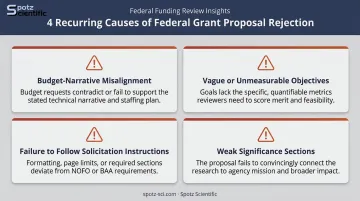
- Budget-narrative misalignment – the scope of work promised doesn't match the requested budget, signaling weak implementation planning to reviewers
- Vague or unmeasurable objectives – goals without a clear, verifiable outcome give reviewers nothing concrete to score
- Failure to follow solicitation instructions – NSF's own policy guide confirms proposals can be returned without review for missing sections or format violations, often before technical review begins
- Weak significance sections – relying on outdated data or failing to connect the problem to the agency's stated mission
Each of these is a preventable execution failure. A careful second read before submission catches most of them.
Final Tips for a Winning Proposal
Get feedback from multiple readers, including domain specialists who can stress-test your science and non-specialists who can flag unclear language. A "red team" style review, where someone actively tries to find every weakness a real reviewer would flag, surfaces problems your own team is too close to see.
An outside reviewer with real federal program experience is best equipped to run this kind of review. Spotz Scientific's red-team proposal review, led by a former DOE ASCR program manager, evaluates draft proposals from the same vantage point used to assess over $264 million in scientific computing research.
A few closing principles:
- Tailor every submission to its specific solicitation, even when much of the underlying content can be repurposed across proposals
- Start early. NSF's own Paperwork Reduction Act estimate puts the burden of preparing a single proposal response at roughly 120 hours, covering everything from reviewing instructions to compiling data
- Build in multiple revision cycles rather than treating the first draft as the final draft
Frequently Asked Questions
How do I structure a grant proposal?
Most proposals follow a core sequence: cover letter or LOI, project summary, statement of need, goals and objectives, methods, and budget. Always defer to the funder's own required order and headings over any generic template.
How long should a scientific grant proposal be?
Lengths vary widely: letters of intent run 1-2 pages, foundation proposals often run 5-10 pages, and federal proposals with attachments can span 15-40+ pages. Always follow the exact page limits stated in the solicitation.
What is the difference between a grant proposal and a grant application?
The proposal is the narrative-and-budget pitch: your case for funding. The application is the full compliance package, including biosketches, certifications, and support documentation submitted through the funder's portal.
What are the 5 Rs of grant writing?
A commonly used framework describes the process as Read, Research, Reflect, Write, and Revise. It's a useful mental model, though it isn't an official standard from NSF, DOE, or other federal agencies.
What is the most common reason federal science grant proposals get rejected?
Budget-narrative misalignment is one of the most common issues. Failing to explicitly address required review criteria, like Broader Impacts or program-specific alignment, is another, and reviewers often flag both before a proposal reaches technical scoring.
Do I need a professional consultant to write a competitive DOE or NSF proposal?
No, but for highly technical, competitive opportunities like DOE ASCR or NSF CISE, it helps. Insider knowledge of agency priorities and review processes, the kind Spotz Scientific provides through red-team reviews, can strengthen a submission before it goes out the door.